PSE&G Is Paying for Your EV Charging Infrastructure. Here Is How Bergen County Property Owners Capture It
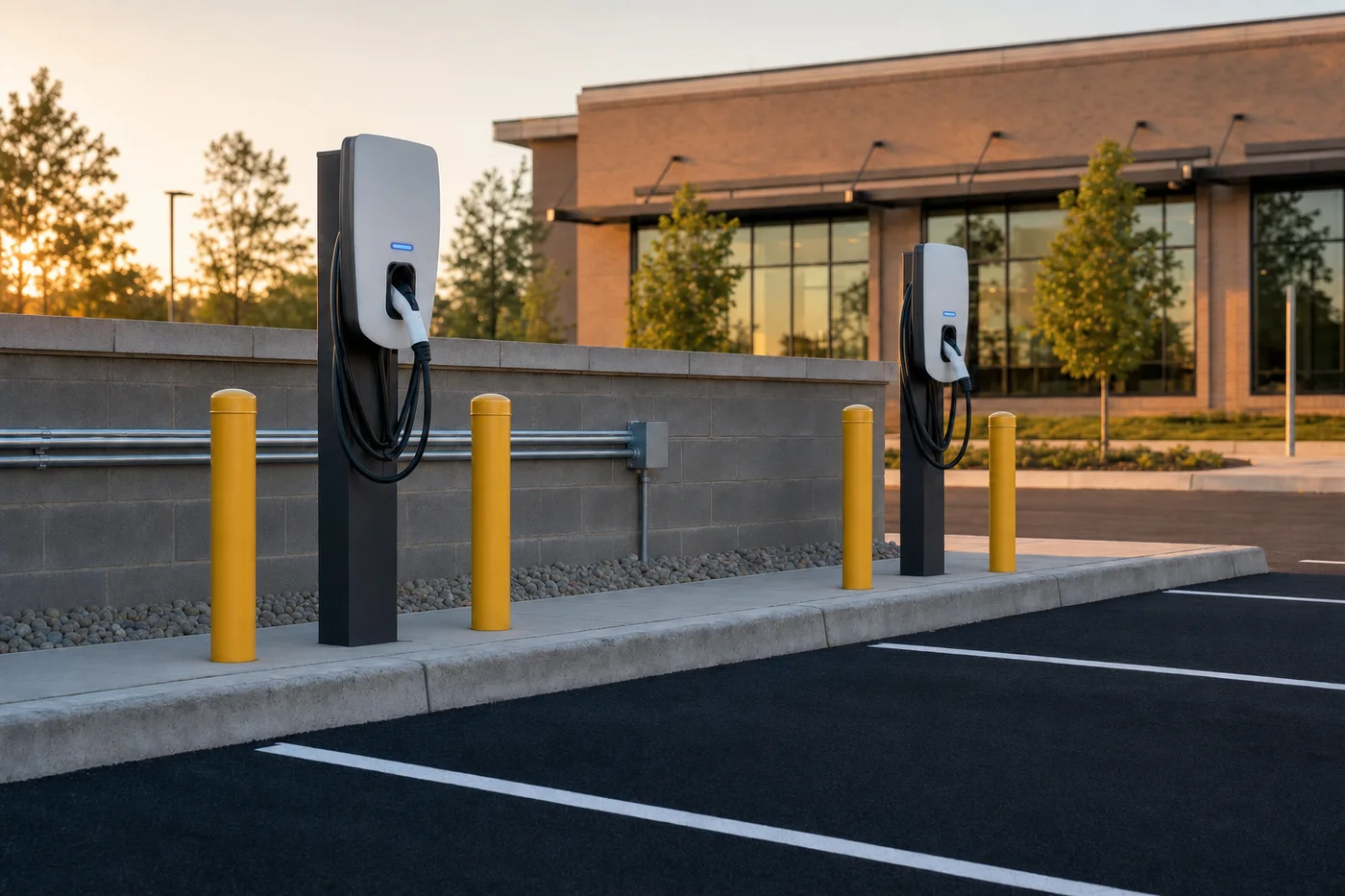
If you own or manage a multi-family building, a municipal facility, or a commercial property with a parking lot in New Jersey, there is money sitting on the table right now, and most owners never claim it.
Public Service Electric & Gas will pay for the electrical infrastructure that makes your property EV-charger ready. Not a coupon. Not a tax form you fight over in April. A direct credit on your PSE&G bill, applied within one to two billing cycles after your paperwork is approved (PSE&G EV Commercial Charging Program).
Here is what the program actually covers, what it does not, and why the properties that move first are the ones that get paid.
What PSE&G Is Actually Offering
The program in question is the Level 2 Mixed-Use Commercial Charging subprogram, approved by the New Jersey Board of Public Utilities back in January 2021 as part of PSE&G's EV Charging Program (PSE&G).
The incentives break down into two buckets:
IncentiveWhat it coversMaximumCustomer-Side Make-Ready (CSMR)Everything behind the meter: panels, switchgear, conduit, wire to the charger stub$7,500 per charger, up to 4 chargers = $30,000 per site (PSE&G)Utility-Side Make-Ready (USMR)Reduction applied to your required PSE&G deposit for service line upgrades and extensionsUp to $10,000 (PSE&G)
That is up to $40,000 of infrastructure cost removed from your project, the exact portion of an EV charging installation that owners always underestimate and that always blows the budget.
One thing to be clear about: this program does not buy your chargers. You pay for the EV charging units themselves. PSE&G pays to get power to them (PSE&G). That distinction matters, because the make-ready work, meaning trenching, conduit, a new panel, possibly a service upgrade, is typically the larger and less predictable half of the job.
Does Your Property Qualify?
The Mixed-Use Commercial subprogram is aimed at (PSE&G):
Multi-family properties, apartment buildings, condo associations, co-ops
Government entities, municipal buildings, schools, county facilities, DPW yards
Property owners who provide charger access to the public, retail centers, medical office buildings, houses of worship, parking operators
On the rate side, commercial customers on General Lighting and Power (GLP) or Large Power and Lighting (Secondary) (LPL-S) rates are eligible for the make-ready incentives (PSE&G).
You also need to clear a few basic gates (PSE&G):
Your PSE&G account must be in good financial standing with no shut-off notice
The charger must be ENERGY STAR certified and Wi-Fi or cellular enabled. This is not optional preference, it is state law under N.J.S.A. 52:27D-141.18 for any Level 1 or Level 2 EVSE manufactured after January 18, 2023 and sold or installed for compensation in New Jersey
You must agree to share charging data with PSE&G
The installation must be performed by New Jersey-licensed electricians and/or contractors
If your chargers will be publicly accessible, PSE&G reviews access case by case, generally expecting availability at least eight hours per day. You are permitted to charge users a fee. It simply has to be clearly displayed (PSE&G).
The Real ROI: Three Ways This Pays
1. Capital cost avoidance, immediately. Removing up to $40,000 of make-ready and utility-side expense from a four-charger project fundamentally changes the math. A project that pencils at a seven-year payback without the incentive can pencil at two or three with it.
2. Revenue and tenant retention. Chargers can be monetized directly through user fees. For multi-family owners, they are increasingly a leasing differentiator, an amenity prospective tenants filter for, at a fraction of the cost of a gym or lounge buildout. For retail and medical properties, a charging session is a 45-minute reason for someone to stay on your property.
3. Stacking. PSE&G's incentives can be combined with other publicly funded state and federal EV programs, as long as total combined funding does not exceed 90% of project cost and you notify both programs of dual participation (PSE&G). Layered correctly, an owner's out-of-pocket exposure gets very small.
4. Future-proofing your service. Here is the part most owners miss. If your project triggers a utility-side upgrade, PSE&G's USMR incentive offsets the deposit for that work. You end up with a larger, more capable electrical service, paid for in part by the utility, that supports far more than chargers down the road. That is a permanent asset improvement, not a line item.
Why "While It Lasts" Is Not a Sales Line
The Mixed-Use Commercial subprogram was funded through a defined BPU-approved allocation, and PSE&G reports semiannually on deployment quantities and remaining balances (PSE&G). Utility make-ready programs across New Jersey are structured to run until their funds are exhausted, not indefinitely.
Add to that the timeline: PSE&G states the full application review process can typically take up to three months(PSE&G). That is before design, permitting, procurement, or a single conduit run. An owner who starts in the fall is realistically energizing chargers well into the following year.
Programs like this reward the prepared, not the interested.
Where Applications Actually Fail
We have seen the paperwork side of utility incentive programs derail otherwise clean projects. PSE&G's documentation requirements are specific (PSE&G):
An itemized contractor invoice marked "PAID" showing detailed scope, labor plus equipment cost, date performed, customer name, installation address, and the contractor's name, license number, and contact information, with the charger cost broken out and excluded if the contractor purchased it
Charger proof of purchase listing manufacturer, model, and power rating, plus a photo of the charger ID/serial number or an app screenshot
Closed municipal permits with permit numbers, and a copy of U.C.C. Form F-222A (Approval for Electrical), or written confirmation from the municipality if no permit is required
Electric service upgrade forms completed by your electrician and emailed to PSE&G's construction group to initiate the New Business Process
Every one of those items is something a disciplined electrical contractor produces as a matter of routine, and something a hurried one produces incorrectly, three weeks late, after your enrollment has stalled. An invoice missing a license number is a rejected application.
How Zimick Electric Handles These Projects
Zimick Electric LLC is a commercial electrical contractor based in Englewood, New Jersey, licensed in the State of New Jersey (NJ Electrical Contractor License #34EB01813400, Business Permit #18134), serving Bergen, Hudson, Essex, and Passaic counties. We work daily with property managers, facility managers, multi-tenant buildings, medical practices, auto dealerships, and municipal clients, exactly the profile this program was built for.
On a PSE&G mixed-use EV project, we handle:
Service capacity assessment, an honest read on whether your existing service supports the load, or whether a utility-side upgrade is in play, before you commit to anything
Load calculations and charger layout, right-sizing charger count and placement against the four-charger incentive cap and your actual parking geometry
Detailed, line-item estimating, our estimates expose labor, material, and scope qualifications clearly, so you know precisely what falls inside and outside the incentive
PSE&G New Business Process coordination, completing the electric service upgrade forms and driving the utility engineering review
Permitting and inspection, municipal permits, U.C.C. Form F-222A, and closed-permit documentation delivered in the format PSE&G's EV Team requires
Complete, compliant installation, panels, switchgear, conduit, and wire to the charger stub, built to code and to last
Incentive documentation package, itemized, properly formatted, license-numbered, and ready to upload to the EV Portal
We do not treat the rebate paperwork as somebody else's problem. Capturing the incentive is part of the scope.
Start With a Conversation, Not a Commitment
The first question is simple: does your property qualify, and what does your existing service actually support? We can answer both without you spending a dollar.
If the answer is yes, we will walk you through a realistic scope, a real number, and exactly how much of it PSE&G is prepared to cover.
Program details in this article are drawn from PSE&G's published EV Commercial Charging Program materials as of September 2026. Incentive amounts, eligibility criteria, and funding availability are set by PSE&G and the New Jersey Board of Public Utilities and are subject to change. Verify current terms directly with PSE&G at 1-800-249-1837 or PSEG-Electric.Vehicles@pseg.com.
Working on something this touches?
We estimate, permit, and self-perform this work across Bergen, Hudson, Essex, and Passaic counties.
Request a bidMore briefs
- October 12, 2026Exit Signs and Emergency Lights: The Fire Code Expects a Test Every Month, Not Just at Inspection
- September 28, 2026New Jersey's Utility EV Charger Programs Are Getting More Time, Not More Money
- September 21, 2026Copper Is Up 20.9 Percent in a Year. Here Is What That Does to an Electrical Budget.